
Politecnico di Torino and R3C Responsible Risk Resilience Centre logo
A research-based visual dashboard developed from the article “Just Territorial Resilience: Disentangling EU Policy Narratives between Geopolitical Stability and Spatial Justice”.
Research dashboardResponsible Risk Resilience CentreEU policy narrativesJust territorial resilience

Just Territorial Resilience

Disentangling EU policy narratives between geopolitical stability and spatial justice through an interactive research dashboard.

About the dashboard →Explore policies →Article download area ↓

Why this study matters

Resilience has become a central concept in EU policymaking, but it does not have a single meaning across EU strategic documents. Since its strong emergence through the European Union Global Strategy in 2016, the concept has expanded from security and geopolitical stability toward climate transition, economic recovery, strategic foresight, territorial cohesion and spatial justice.

This study examines how key EU policy documents frame resilience by asking: resilience of whom, to what, through which capacities, where, when and for what purpose? The comparative analysis shows that EU resilience discourse is mainly shaped by economic/financial and green/climate framings, while territorial, place-based and justice-oriented dimensions remain underrepresented.

This gap matters because crises and transitions affect territories unevenly. Moving toward just territorial resilience means recognising differentiated vulnerabilities, supporting weaker territories, strengthening participatory governance and linking resilience with redistribution and spatial justice.

Published article preview

Click the first page preview to open the published article, or use the DOI button for the citation record.
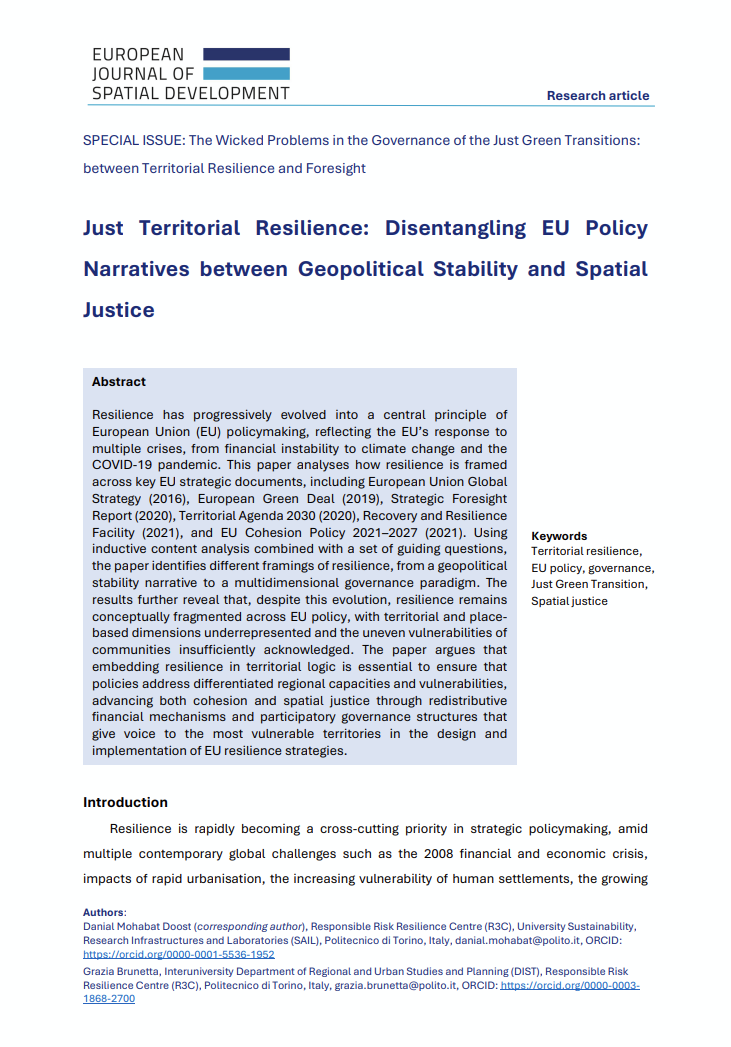
First page preview of the published article Just Territorial Resilience
Dashboard description

About this research dashboard

This web-based dashboard is based on the results of the research article “Just Territorial Resilience: Disentangling EU Policy Narratives between Geopolitical Stability and Spatial Justice”, developed within the Responsible Risk Resilience Centre (R3C) at Politecnico di Torino.

The dashboard translates the article’s qualitative content analysis into an accessible visual and interactive format. It allows users to navigate different EU policy documents, understand how each one frames resilience, compare the main policy narratives, and identify the critical gap highlighted by the research: the need to move from fragmented resilience discourses toward just territorial resilience.

Suggested use: this dashboard can support academic discussion, teaching, policy communication, dissemination activities and future updates linked to the publication of the article.
Authors and credits

Danial Mohabat Doost

Research Manager at the Responsible Risk Resilience Centre (R3C), an interdisciplinary research centre at Politecnico di Torino dedicated to advancing urban resilience.

Grazia Brunetta

Full Professor of Urban and Regional Planning at Politecnico di Torino (PoliTo), DIST – Interuniversity Department of Regional and Urban Studies and Planning. She is the Scientific Coordinator of the Interdepartmental Centre Responsible Risk Resilience Centre (R3C) of Politecnico di Torino, where she leads an interdisciplinary research team focused on implementing resilience into spatial planning and policy design.

Dashboard credit:
Visual translation based on the article’s results, comparative analysis and conclusions. Created by Danial Mohabat Doost.
Policy timeline

Click a policy to read its resilience definition and focus

The timeline follows the article’s selected EU policy documents and translates each document’s definition of resilience into a readable policy card.

Select one policy document. The coloured bar on the left corresponds to the colour of the selected policy card.

Comparative analysis

Comparative matrix of EU resilience framings

This section compares how resilience is framed across the selected EU policy documents, highlighting the dominant narratives, recurring themes, and underrepresented dimensions in the EU resilience discourse. For the full description of the methodology and analytical process, please refer to the full paper.

Dominant dimensions

Economic/financial and green/climate resilience emerge as the most prominent dimensions in the comparative analysis, showing how EU resilience discourse is strongly shaped by recovery, investment, sustainability and climate-transition concerns.

Territorial exception

Territorial and place-based resilience appears as a dominant framing only in the Territorial Agenda 2030.

Justice gap

Just transition and community vulnerability appear explicitly only in the Green Deal within the comparative table.

Meta-themeEUGSGreen DealForesightTerritorial AgendaRRFCohesion Policy
Conclusion representation

From EU resilience discourse to just territorial resilience

This pathway summarises the article’s final argument: resilience has become central in EU policy, but it needs stronger territorial, redistributive and participatory grounding.

5. ProposalThe proposal of this research becomes operational through three connected principles

Territorial differentiation

Just territorial resilience starts from the recognition that territories do not face crises or transitions from the same starting point. Policies should therefore account for differentiated vulnerabilities, capacities, resources and institutional conditions across places.

Grounded in territorial resilience and place-based vulnerability literature: Brunetta et al. (2019; 2025).

Redistribution and spatial justice

Resilience instruments should ask who benefits, who bears the costs, and which territories need greater support. This requires linking resilience to redistributive mechanisms, spatial justice and the fair allocation of transition burdens and benefits.

Connected to justice and resilience debates: Rawls (1971), Fraser (1997), Schlosberg (2004), Davoudi (2018).

Participatory governance

Vulnerable territories and communities should have meaningful voice in defining resilience priorities. Participatory and multi-level governance helps avoid technocratic resilience and supports locally embedded transition pathways.

Aligned with institutional and governance perspectives: Ostrom (1990), Fainstein (2010).
Article access

Download the full article

Use the published article page or the DOI link below.

Published article: https://journals.polito.it/index.php/EJSD/article/view/557

DOI: https://doi.org/10.5281/zenodo.20340705

How to cite

Mohabat Doost, D., & Brunetta, G. (2026). Just Territorial Resilience: Disentangling EU Policy Narratives between Geopolitical Stability and Spatial Justice. European Journal of Spatial Development, 23(3). https://doi.org/10.5281/zenodo.20340705

Article first page preview

Click the preview to open the journal page.